

You know that feeling when a tool you've trusted for years goes quiet? That's MWS right now. Amazon's December 2025 docs say it clearly: move to SP‑API or stay stuck on legacy rails.
This isn't a nudge; it's a roadmap. The new MWS‑to‑SP‑API Migration Guide shows how to move without breaking prod. You'll also get new features, better visibility, and cleaner docs. No more digging through ancient READMEs like it's a museum.
If you've been doomscrolling 'documentation updates reddit' or refreshing 'documentation updates github' for crumbs, breathe. This guide cuts the noise and shows the path from MWS to SP‑API. Fast, safer, and with fewer WTF moments, promise.
Bottom line: if your stack touches orders, feeds, reports, pricing, or catalog, this is your sign. The route is mapped, the auth is modern, and the tooling is saner. Plan the migration, dual‑run to reduce risk, and enable notifications. Stop paying the polling tax. Future you will sleep better.
TLDR
- December 2025 docs push faster migration from MWS to SP‑API.
- Map core MWS endpoints to SP‑API, then dual‑run before final cutover.
- Treat docs like code: version, review, and ship alongside releases.
- Use GitHub and Reddit for feedback loops; track 'seo updates' in Search Console.
- Expect better auth, tighter scopes, and stronger monitoring with SP‑API.
December update changes
Shift parity plus progress
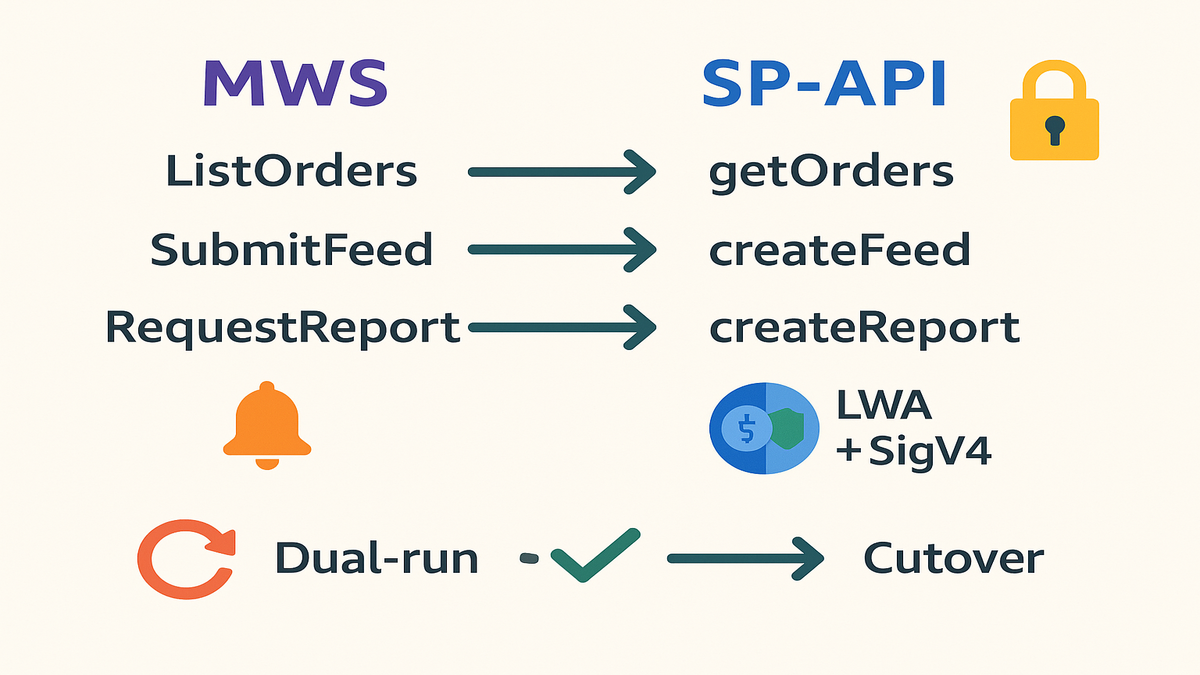
December 2025 docs add needed clarity. SP‑API isn't just 'MWS but newer.' It's a new architecture with granular permissions, standard auth with LWA and SigV4, and explicit rate limits. The refreshed guide shows endpoint mappings and scope shifts. You can plan with confidence now.
First‑hand example: if you call MWS ListOrders today, use SP‑API Orders getOrders. Authenticate with LWA and sign using SigV4. Request marketplace data via parameters. Align throttling to operation quotas, not account buckets. Same job, tighter control.
A few practical shifts you'll feel on day one:
- Auth lifecycle: manage short‑lived LWA access tokens and sign each request with SigV4. It separates identity from authentication, which helps with debugging and rotations.
- Regional endpoints: plan for regional base URLs across North America, Europe, and Far East. Keep per‑region configs and alerts, so issues aren't hidden by a global dashboard.
- Idempotency: when supported, use idempotency tokens to make retries safe. This kills many duplicate‑feed ghosts.
- Pagination and filtering: expect more consistent pagination. Use filters to narrow results and reduce throttling.
Beyond parity features you use
- Fine‑grained scopes grant only what's needed per app or partner. Cleaner audits and fewer reviews.
- Webhooks‑style notifications through the Notifications API cut polling costs and timeouts.
- Better discoverability: SP‑API docs are consolidated and cross‑linked. Models and examples live in public GitHub repos.
If you've asked 'maintain documentation meaning' in Slack, here's the answer. Treat docs, code, and configs as one deployable unit. The December update leans into that with clearer migration paths. Sandbox flows and GitHub‑hosted specs help you point pull requests at the source of truth.
First‑hand example: many teams migrate catalog writes first. Think Feeds and Reports to Feeds v2021-06-30 and Reports v2021-06-30. Then they tackle Orders and Notifications. Chunk by capability, not by monolith.
References: SP‑API docs are centralized here: SP‑API docs
MWS to SP API mappings
Use the official mapping tables, but here's a quick cheat sheet to plan:
- Orders: MWS ListOrders → SP‑API Orders
getOrders; ListOrderItems →getOrderItems - Feeds: MWS SubmitFeed → SP‑API Feeds
createFeedandcreateFeedDocument; GetFeedSubmissionList →getFeeds - Reports: MWS RequestReport → SP‑API Reports
createReport; GetReport →getReportDocument - Products/Catalog: MWS Products API calls → SP‑API Catalog Items and Listings Items. It varies by use case.
- Pricing: MWS Products pricing calls → SP‑API Product Pricing and Listings APIs. Scope dependent.
Always verify operation names, request and response models, and scopes in the latest docs. Do that before you ship any code.
Security and compliance superpowers
- Restricted Data Token: for PII or restricted fields, request RDT to tighten scope. This reduces exposure and speeds approvals.
- Principle of least privilege: scope by integration. Split machine roles for read‑only and write paths.
- Secret hygiene: store LWA secrets and AWS keys in a vault. Rotate on a schedule and alert hard on token refresh failures.
Why migrate now
Support windows and risk math
Running on MWS in 2025 is like shipping on an old framework past LTS. Quiet until it isn't. December's docs nudge you to move now for continued support and new features. Translation: don't wait for a last call to hit peak sales.
First‑hand example: a merchant ops team waited until throttling changed during their highest‑order week. Their patch worked, but it cost a sprint and a weekend. With SP‑API, they used notifications and leaner requests. They dodged the burst entirely.
Think of a simple two‑by‑two. Do low effort, high impact items first, like Orders reads, key Reports, and Feeds. Then high effort, high impact work, like complex listing updates and multi‑region rollout. Skip nice‑to‑haves until parity is stable.
Reliability and visibility
SP‑API gives operation‑level throttling guidance, consistent errors, and cleaner retry patterns. That means fewer mystery failures. With sandbox endpoints, you can simulate flows before production. You ship with less guesswork.
Docs tie‑ins:
- Authentication is explicit with LWA and SigV4. You can monitor auth separate from business logic.
- Scopes isolate permissions per integration. Smaller blast radius when things go sideways.
- Public GitHub specs and models keep SDKs aligned with reality, not guesses.
Add a few guardrails and you'll feel the calm:
- Use exponential backoff with jitter for 429s. Don't hammer. Adapt.
- Tag requests with end‑to‑end correlation IDs. When support asks for
x-amzn-RequestId, you have it. - Split alerts for expected throttling and unexpected spikes. Different playbooks, different urgency.
If you care about 'update search' and 'seo updates,' the lesson is the same. Clear instrumentation and fresh docs speed diagnosis. Migrate now, test hard, and you'll cut mean time to recover.
Reference: Selling Partner API models and docs on GitHub: selling-partner-api-docs and selling-partner-api-models
Plan migration safely
Inventory map and parallelize
Start with a real inventory. List MWS endpoints, data flows, schedules, and dependencies. Map each one to its SP‑API replacement and note scopes. Prioritize high‑churn or high‑value flows first. Orders, Catalog, Feeds and Reports usually pay off fastest.
First‑hand example: run a dual pipeline. Keep MWS live and stand up SP‑API beside it. Mirror a slice of traffic. Diff payloads and outcomes. When gaps are near zero for a full sales cycle, flip primary to SP‑API. Keep MWS as fallback for a short, time‑boxed window.
Make the mapping concrete with a lightweight workbook:
- Columns: MWS call, SP‑API operation, scope, rate‑limit notes, marketplaces, owner, and status.
- Add test cases per row, including edge cases like cancellations, partials, and out‑of‑stock.
- Define parity with measurable criteria. For example, 99.5% matching order counts over 30 days.
Auth scopes and observability
- Authentication: use Login with Amazon for tokens and AWS SigV4 for signing.
- Scopes: grant the minimum needed per app. Review scopes quarterly, for real.
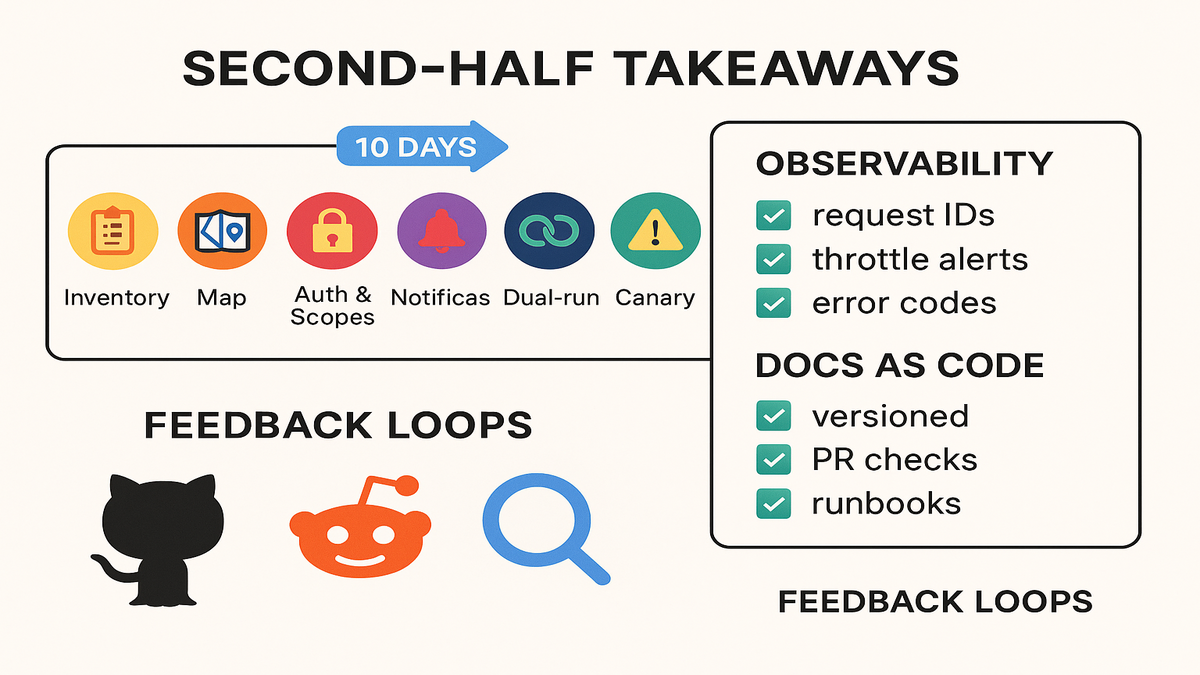
- Observability: tag by operation and marketplace. Capture request IDs and error codes. Alert on throttle thresholds and auth failures.
Community intel helps a lot. Track 'documentation updates github' for change logs and examples. Browse 'documentation updates reddit' threads for edge cases and gotchas. Use that feedback loop to harden your rollout. Do it before customers find your blind spots.
Useful references: LWA docs and AWS SigV4
A few more pragmatic tips:
- Token refresh: build a background refresher with early renewal and retries. Log failures loudly.
- Secrets: use per‑environment credentials and short‑lived IAM permissions when possible.
- Regions: keep configs per region for endpoints and scopes. Avoid drift and fail forward cleanly.
Cutover mechanics
- Canary first: ship to a small seller cohort or one marketplace. Watch for anomalies before widening.
- Feature flags: make SP‑API togglable by endpoint and marketplace. Roll forward or back without redeploys.
- Data reconciliation: automate diffs between MWS and SP‑API outputs. Alert on variances beyond a tiny threshold.
- Rollback window: time‑box the MWS fallback. Open‑ended fallbacks never end.
Documentation as velocity
Docs as code
Docs aren't homework. They're your team's memory. Keep docs in the repo, versioned with code. Add pull request checks for example requests, scopes, and rate‑limit notes. Each release updates both code and docs. That's how you maintain documentation in practice.
First‑hand example: create a /docs/integrations/sp-api/ path with:
- Endpoint mappings from MWS to SP‑API
- Required scopes per feature or flow
- Error catalog and retry rules that engineers trust
- Runbooks for sandbox, staging, and production environments
Add a tiny toolchain to keep it honest:
- Link checker: fail pull requests on broken links.
- Snippet tests: validate examples against the latest OpenAPI models.
- Changelog discipline: note what changed, why, and who should care.
Feedback loops
- GitHub: watch the SP‑API docs and models repos for schema changes.
- Reddit: scan r/AmazonSeller and r/aws for migration stories and warnings.
- Search hygiene: treat your wiki like a public site. Clean URLs, fresh sitemaps, and solid structure. For public docs, use Google Search Console to catch 404s and bad redirects during your 'search console update' sweeps.
This is where 'seo updates' stop being just marketing. Good structure, canonical links, and fresh examples make docs discoverable. Devs find the right answer the first time.
References: Google Search Central blog
Quick pulse check
- December 2025 docs nudge you to speed up SP‑API migration.
- Map endpoints, set scopes, and dual‑run to de‑risk the cutover.
- Use LWA plus SigV4 and monitor auth apart from business logic.
- Keep docs versioned with code and ship docs with releases.
- Track changes via GitHub and Reddit, and keep Search Console clean.
FAQ
Q: Is MWS still supported?
A: The December 2025 docs encourage accelerating your move to SP‑API. That ensures support and access to new features. If you rely on MWS, plan now to avoid surprises.
Q: What's the SP‑API equivalent for common MWS calls?
A: Examples: MWS ListOrders → SP‑API Orders getOrders. MWS SubmitFeed → SP‑API Feeds createFeed and createFeedDocument. MWS RequestReport → SP‑API Reports createReport and getReport. Always verify names and payloads in the official docs.
Q: Do I need new auth?
A: Yes. SP‑API uses LWA for access and refresh tokens, plus AWS Signature Version 4 for signing. You'll also request fine‑grained scopes per app.
Q: How do I test safely?
A: Use the SP‑API sandbox, then stage your rollout. Mirror non‑critical traffic, compare outputs, and promote after a stable window. Keep MWS as a short, time‑boxed fallback.
Q: What about rate limits?
A: Limits are operation specific. Use exponential backoff, respect quotas, and monitor x-amzn-RequestId and error codes. Replace polling with Notifications when possible.
Q: Where do I track documentation updates?
A: Follow the official SP‑API docs and GitHub repos for change logs. Reddit communities like r/AmazonSeller and r/aws surface edge cases fast.
Q: Do I need Restricted Data Token?
A: If you access PII or other restricted fields, yes. Request RDT to tightly scope and audit that access. It limits exposure and helps compliance reviews.
Q: How long should I dual‑run?
A: Long enough to cover a normal sales cycle and known spikes. Many teams run two to four weeks with parity metrics. End it with a scheduled cutover.
Q: What about client libraries?
A: Start with official models and OpenAPI specs from GitHub. Use or build a thin client that handles auth, retries, and logging. Keep it small so updates are painless.
Q: Any hidden gotchas on payloads?
A: Expect differences in field names, pagination, and error shapes. Normalize early in adapters and write contract tests that pin structures.
10 day SP API sprint
- Day 1–2: inventory MWS calls, data flows, schedules, and dependencies.
- Day 3: map to SP‑API operations and scopes. Setup LWA and SigV4.
- Day 4: build sandbox tests. Generate fixtures and compare payloads.
- Day 5–6: implement core flows like Orders and Feeds and Reports. Add retries and logging.
- Day 7: wire Notifications to cut polling, where available.
- Day 8: dual‑run in staging. Diff outcomes and tune throttling.
- Day 9: canary release in production with feature flags.
- Day 10: flip primary to SP‑API. Keep MWS fallback for a short, fixed window.
Pro tip: use this sprint as a playbook, not a cage. If Orders drives your business, do that first and win fast. If Feeds is the hardest part, front‑load it to reduce late risk.
You don't need to be first. You need to be deliberate, observable, and fast.
Wrap this up: SP‑API isn't just the new endpoint of the week. It's cleaner permissions, standard auth, and a docs ecosystem that reduces drift. The December 2025 updates make one thing obvious. Migrating now buys stability later. Treat docs like code, dual‑run to de‑risk, and listen to GitHub and Reddit. You'll spot issues early. When the next urgent update lands, your system just keeps humming.
References
- Selling Partner API documentation
- Selling Partner API docs (GitHub)
- Selling Partner API models (GitHub)
- Login with Amazon (LWA) documentation
- AWS Signature Version 4
- Restricted Data Token (SP‑API)
- Notifications API overview (SP‑API)
- Google Search Central blog (Search Console, SEO updates)
- r/AmazonSeller (community discussions)
- r/aws (developer discussions)