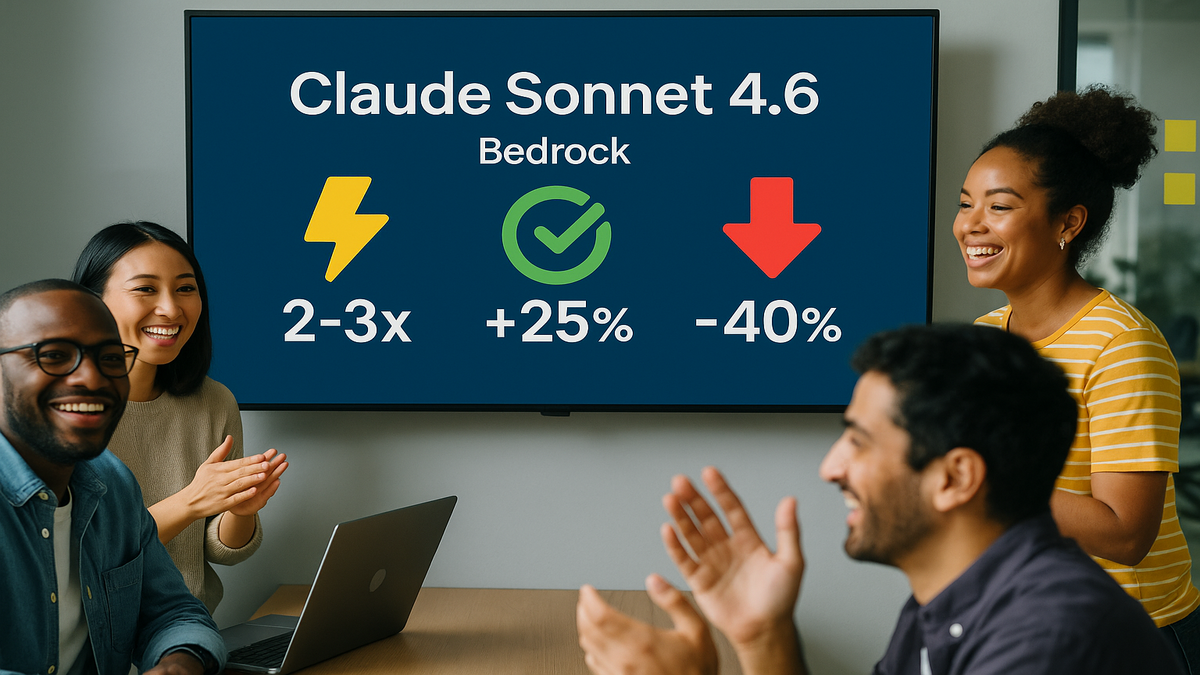


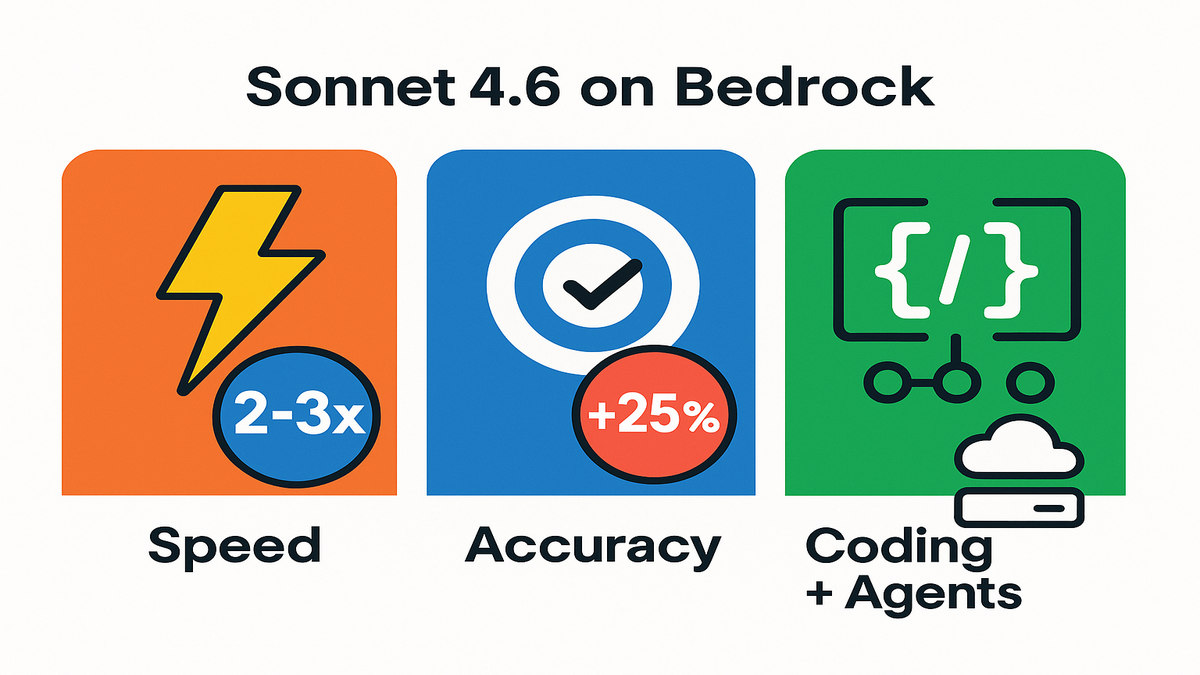
You want more output for less money. Claude Sonnet 4.6 on Amazon Bedrock makes that trade real now. Early users report 2–3x faster agent replies and up to 25% better pro-task accuracy. Plus up to 40% lower inference costs than prior flagship models.
Wait, cheaper and better, is that real or just hype? Yes, it’s live today wherever Bedrock runs, no waiting needed. You can slot it into coding pipelines, agent stacks, and knowledge workflows, hassle-free. If you’ve waited for that sweet spot of brains and business fit, this is it.
You’ll get stronger coding with fewer hallucinations and tighter logic out the box. You also get long-context reasoning for multi-step agents, plus provisioned throughput for guaranteed scale. The kicker: it plugs into Bedrock Guardrails and Knowledge Bases, so apps stay safer and grounded without duct-taped tools—let’s ship.
Bottom line: this is the kind of upgrade that moves a P&L. Faster loops close more tickets, merge more code, and cut weekend fire drills. If your team’s stuck in pilot purgatory, Sonnet 4.6 on Bedrock pushes you from demo to dependable.
TL;DR
- Sonnet 4.6 is live on Amazon Bedrock in all supported AWS Regions, with frontier-level performance at a lower cost profile.
- Expect 2–3x speedups in agent responses and up to 25% better accuracy in pro tasks.
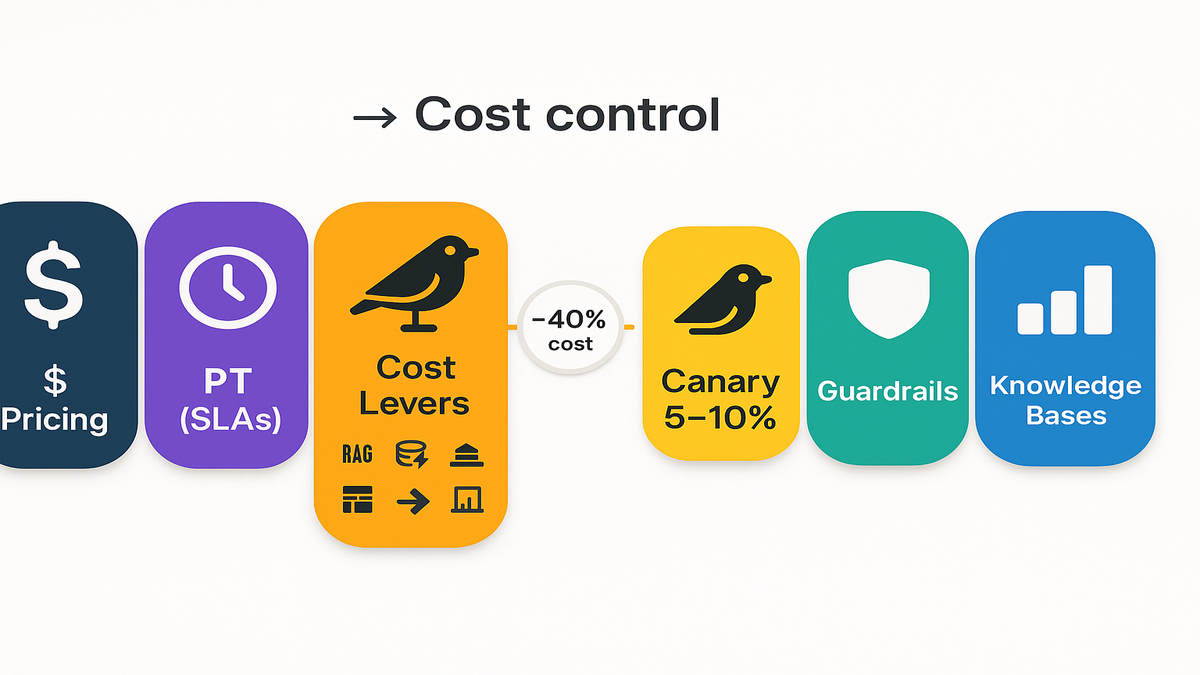
- Inference costs can be up to 40% lower than previous flagships (per early reports).
- Use Bedrock guardrails, knowledge bases, and provisioned throughput to scale safely.
- For pricing, check AWS Bedrock’s pricing page; it varies by region and usage.
Why Sonnet 4.6 Is Real
Coding that ships faster
Sonnet 4.6 brings better reasoning and fewer hallucinations to daily coding. It generates, debugs, and optimizes across many languages with fewer retries and gotchas. In practice, that means cleaner diffs, tighter tests, and less spelunking through flaky outputs. It also handles long files and cross-file logic better, so you can feed real project context.
Here’s how teams are turning that into speed:
- Structure responses. Ask for diff-only patches, unit tests first, or a risk checklist before code.
- Anchor to your repo. Pair Bedrock Knowledge Bases with READMEs, design specs, and common pitfalls for grounding.
- Make the model explain. Require a one-paragraph rationale before the patch to catch drift early.
- Keep outputs machine-friendly. Request JSON for file changes, test names, and impacted modules for easy parsing.
Pro tip: set a standard prompt template for “write tests, then write code.” Tests force clarity and block the classic false-positive pass where it “fixes” the wrong thing. A tighter loop today saves you rework on Friday at 6 p.m.
Agents that keep their head
Long, branching tasks is where agents melt down. Sonnet 4.6’s long-context reasoning supports multi-step, tool-using flows with fewer derailments. It plans, executes, and checks work across steps, great for RAG+tools, orchestration, and customer assistants that can’t hallucinate your roadmap.
To keep agents reliable, wire in a few staples:
- Planner → actor → checker. Plan steps, call tools, then self-check against acceptance criteria before final, with private thoughts.
- Guard against loops. Cap tool-call retries and stop when no new info appears, and log stuck states.
- Tight tool schemas. Define inputs and outputs clearly with types, ranges, and enums to cut drift.
- Retrieval sanity. Ask for citations and IDs on every chunk; escalate on low confidence or ask clarifying.
Result: agents that can plan, do, and verify—without wandering off into fantasy land.
Enterprise grade at scale
You can run Sonnet 4.6 with provisioned throughput in Bedrock for consistent latency and capacity. That means safer SLAs for support bots, analyst copilots, and back-office automations. Tied into Bedrock Guardrails and Knowledge Bases, you’ll ship governed apps faster without a bespoke policy engine.
Scaling playbook:
- Predictable performance. Provisioned throughput stabilizes P95 and P99 during peak hours with fewer cold starts.
- Observability by default. Track token usage, tool-call counts, and retrieval hit rates in your APM.
- Safer by design. Guardrails block out-of-policy content, and Knowledge Bases keep answers grounded.
- Easy rollbacks. Canary new prompts or routing behind flags, and fail back within minutes if needed.
First hand example
You connect Sonnet 4.6 to your CI bot: it summarizes pull requests, proposes tests, and explains failing builds. In the first sprint, review time drops 30% and rework falls as suggestions match repo context. Devs stop pasting stack traces into Slack and start merging faster.
Add one more week, and the CI bot flags risky migrations before they land with short rationales. It tags owners automatically so senior devs focus on architecture, not whitespace debates. Small win, big morale.
Pricing Throughput Cost Levers
Find Sonnet 4.6 pricing
AWS posts model rates on the Bedrock pricing page, which vary by Region and usage. The headline: Sonnet 4.6 targets up to 40% lower inference costs than prior flagships while approaching Opus-class intelligence. Translation: you get better reasoning per dollar. Always check live numbers before you scale.
Practical cost math:
- You pay for what you send and what you generate, both matter.
- Retrieval can replace tokens. Move docs to a Knowledge Base and pull only relevant chunks.
- Streaming doesn’t change content cost, but speeds perception so pipelines start work sooner.
Provisioned throughput and SLAs
Provisioned throughput in Bedrock lets you lock capacity and latency for production. It’s the enterprise “don’t page me at 2 a.m.” option for contact centers, batch knowledge, and high-QPS copilots. You pay for reserved capacity and stop rolling the dice on noisy neighbors. Docs here.
Sizing tips:
- Start from baseline QPS and P99 targets, then add margin for bursts using canary data.
- Right-size by workload. Split steady support chat from spiky end-of-month finance jobs.
- Keep an on-demand path. Burst to on-demand if you outgrow capacity while adjusting reservations.
Cost control tactics
- Right-size context: keep prompts lean; move documents to Knowledge Bases and reference them.
- Cache aggressively: memoize tool results and use RAG instead of massive prompts.
- Tier models: use smaller models for triage; Sonnet 4.6 for hard steps.
- Stream outputs: start post-processing early to cut wall time in pipelines.
- Batch wisely: queue non-urgent jobs to off-peak windows if architecture benefits.
- Compress prose: ask for concise answers and structured fields to trim tokens.
- Early stop: set clear acceptance rules so the model ends when done.
- Log sampling: keep full logs for a slice; sample the rest to cut storage.
- Fail fast on low-confidence: require citations or confidence tags; escalate if missing, don’t waste tokens.
First hand example
Your finance ops team processes 10k PDFs nightly. With Sonnet 4.6, you move from full-document prompts to chunked RAG via Bedrock Knowledge Bases. Same extraction quality with fewer tokens. Net result: throughput meets SLA and monthly inference cost drops double-digits.
Bonus: you add a tiny post-processor that flags outliers for human review. Humans touch only the weird cases, and the rest flows straight to the ledger.
Pause and Recap Sonnet 4.6
- Sonnet 4.6 is live in Bedrock with faster agents and stronger coding.
- Costs can be up to 40% lower than older flagships; verify pricing by Region.
- Use provisioned throughput for predictable latency and scale.
- Lean prompts + Knowledge Bases + caching = big savings without quality loss.
- You can migrate from prior Claude versions via the same Bedrock APIs in minutes.
If you do nothing else this week: pick one workflow, run a small offline eval against your current model, and see if Sonnet 4.6 clears the bar. If it does, canary. If it doesn’t, tweak prompts and retrieval once. The loop is the product.
From Console to Production APIs
Console quick start
In the Bedrock console, pick Claude Sonnet 4.6, paste a prompt, and test. Flip on streaming if you want faster perceived latency right away. Try a realistic workflow with a repo snippet, support transcript, or a long-form summary task. Validate outputs before wiring into anything customer-facing: AWS Bedrock.
While you’re there, save a prompt template, try a few temperature settings, and toggle citations if using a Knowledge Base. Take ten minutes to compare verbose and concise outputs. You’ll see where to shave tokens with zero quality loss.
API migration in minutes
Already on Claude via Bedrock? Swap the model ID to Sonnet 4.6, keep safety and knowledge settings, then redeploy. Bedrock client SDKs smooth sharp edges so you move fast. Start with a canary path, route 5–10% to 4.6, compare quality, latency, and token costs, then ramp.
Good hygiene:
- Version prompts with code. Small prompt changes can shift both costs and accuracy.
- Add request IDs and trace tool calls. When it breaks, you want breadcrumbs.
- Keep a rollback lever. One flag flips you back if a regression appears.
Guardrails and knowledge
Enable Bedrock Guardrails to enforce policies like PII, toxicity, and allowed topics. Pair with Knowledge Bases so Sonnet 4.6 cites your actual docs instead of guessing. That combo is the gap between “sounds smart” and “is compliant.” Docs: Guardrails and Knowledge Bases
Make it tangible:
- Guardrails for tone and limits. Block medical, legal, or financial advice if off-limits, and auto-redact sensitive fields.
- Knowledge for grounding. Point to policies, FAQs, and specs; require citations with each answer for trust.
First hand example
You pilot a customer-support copilot. With Guardrails, it never invents discount policies; with Knowledge Bases, it quotes the latest warranty terms. CSAT rises, escalations fall, and legal sleeps fine at night.
When peak season hits, you add provisioned throughput. The copilot keeps P95 under SLA without melting when volume spikes.
Smarter Agents Long Context
Design multi step planners
Treat Sonnet 4.6 like your orchestrator brain. Give it tools like search, code exec, and DB queries. Ask it to plan, execute, and verify with a clear structure. Keep chain-of-thought private but require explicit tool outputs and final answers.
Implementation details that pay off:
- Structured plans. Ask for numbered steps with inputs, tools used, and success criteria per step.
- Idempotent tools. Use a correlation ID and dry-run option so retries don’t double-charge.
- Memory window. Summarize prior steps to stay lean, but keep key IDs and facts.
Evaluate and iterate
Instrument agents carefully. Track success per step, not just per session, like retrieval hit rate. Measure tool call accuracy, correction loops, and your latency budget every week. Consider a light evaluator where Sonnet 4.6 rates drafts against references.
What to measure weekly:
- Correctness against a golden set that reflects your data.
- Escalation rate to humans; lower is better, but never zero for safety.
- Token cost per task and per successful outcome over time.
- Time-to-first-byte and total latency; both shape user experience.
Latency vs accuracy levers
Long context is powerful, but tokens are not free. Use summaries, vector search, and citations to stay lean. For speed, stream intermediate steps and parallelize tool calls. For quality, set acceptance criteria and require self-checks before final.
Trade-offs that work:
- Tighten retrieval top-k until quality dips, then back off one notch.
- Ask for short bullets first and full prose only when needed.
- Batch external API calls and cache them for the session.
First hand example
Your sales agent drafts proposals from CRM and product sheets. Sonnet 4.6 plans sections, retrieves specs via Knowledge Bases, runs a pricing tool, then validates totals. Result: cleaner proposals, fewer manual reviews, and 2–3x faster drafts.
After rollout, you add a risk checker that scans for missing legal clauses and edge discounts. That one step kills a week of back-and-forth each quarter.
FAQ Claude Sonnet 4.6
1. Sonnet 4.6 release date
It’s available now in AWS Regions where Amazon Bedrock operates. You can select it in the Bedrock console or via APIs. Check Region availability here.
2. Sonnet 4.6 different
Opus targets maximum capability; Sonnet aims for frontier-level power at much lower cost. In practice, Sonnet 4.6 nears Opus-like intelligence for many workflows. It still delivers up to 40% lower inference costs versus prior flagships, a strong default for volume.
3. Sonnet 4.6 price Bedrock
Pricing is published on the AWS Bedrock pricing page and varies by Region and usage. That includes input and output tokens and provisioned throughput if you use it. The big idea: similar or better outcomes for less spend vs older flagships. Always validate current rates.
4. Sonnet 4.6 long-context agents
Yes. It’s optimized for long-context reasoning and multi-step agent interactions. Combine it with Bedrock Agents, Guardrails, and Knowledge Bases for safer, reliable workflows.
5. Customize behavior or data
Absolutely. Use system prompts for behavior, Guardrails for policy, and Knowledge Bases for RAG. That setup cuts hallucinations and keeps outputs aligned with your docs.
6. Read real world feedback
Expect early breakdowns and configs on Reddit and dev forums soon. Look for latency charts, prompt patterns, and cost curves from teams moving over. Cross-check claims against your own evals before pushing to production.
7. Streaming responses
Yes. Bedrock supports streaming so you can read tokens as they’re generated. That cuts perceived latency and enables earlier post-processing. See the runtime streaming API.
8. Migration gotchas
Keep prompts, guardrails, and knowledge configs the same for your first test. Then tune temperature, response length, and retrieval settings for your stack. Also watch for style differences and standardize with explicit format rules.
9. Evaluations
Use a small, representative golden set drawn from your own data. Score correctness, helpfulness, safety, latency, and cost per successful task. Re-run weekly as prompts or docs change. Great evals are boring, repeatable, and fast to run.
Launch Sonnet 4.6 Quick Checklist
- Pick a high-impact workflow (coding bot, support copilot, document analysis).
- Run baseline: quality, latency, token cost with your current model.
- Switch to Sonnet 4.6 in Bedrock console; validate on real samples.
- Add Guardrails and connect a Knowledge Base for grounding.
- Canary deploy via API; ship to 5–10% of traffic.
- Track evals: accuracy, escalation rate, token usage, time-to-first-byte.
- Optimize prompts and retrieval to trim tokens without losing accuracy.
- Consider provisioned throughput for production SLAs.
- Roll out broadly once metrics beat baseline.
Great models don’t win on benchmarks—they win in your stack. Sonnet 4.6 on Bedrock is built for that: fast, grounded, and cost-aware. Start small with a canary, measure obsessively, then scale what clears your bar. If a model’s going to replace meetings, glue workflows, and close tickets while cutting compute, this is the one to trial first.
“In 2024+, the best AI teams won’t just pick smarter models—they’ll ship cheaper, faster loops. Sonnet 4.6 is a loop accelerator.”
Working on Amazon Marketing Cloud workflows or retail media analytics copilots on AWS? Explore AMC Cloud to centralize AMC pipelines and governance alongside your Bedrock agents.
Want to operationalize complex AMC SQL and reporting with agent-friendly outputs? Check out Requery.