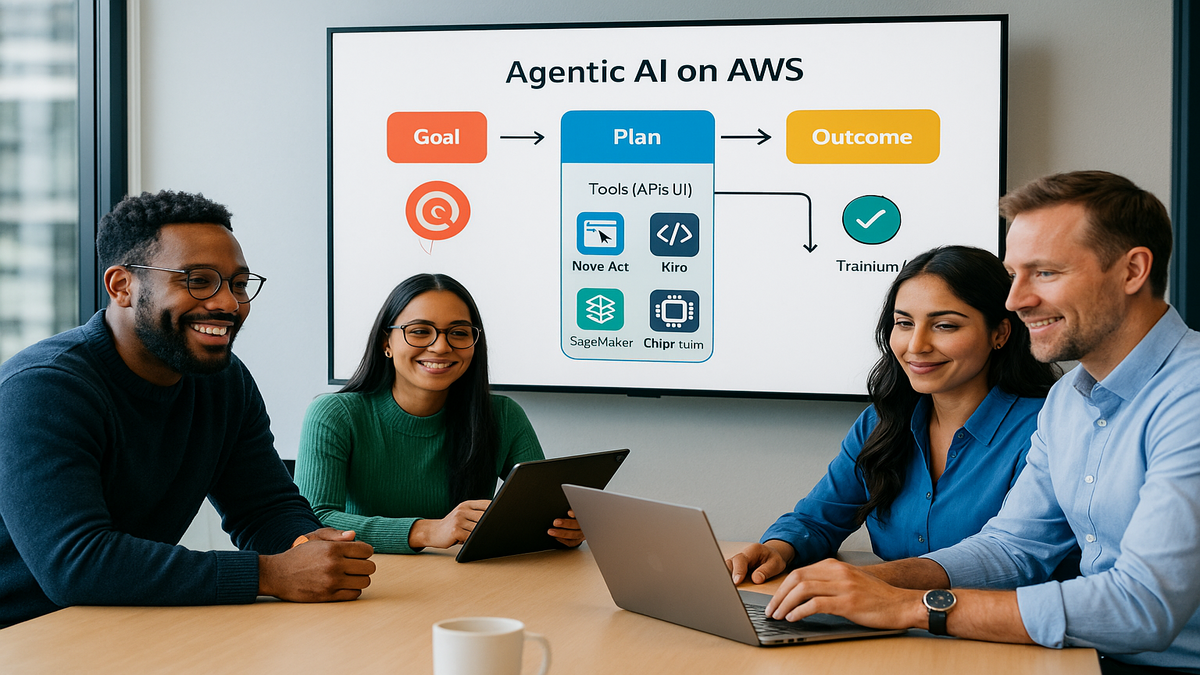


The best “junior teammate” you’ll hire this year won’t sign a W-2. It’ll ship code, click through UIs, and never ask for Fridays off.
If you still treat AI like a chat toy, you’re leaving money behind. Agentic AI leveled up from reactive chats to proactive digital teammates. They plan, reason, and execute multi-step work end to end. AWS is betting big with a stack built for speed, scale, and trust.
The headline: go from idea to a production-grade agent fast. One that works across tools, APIs, and UIs without duct-taping twelve services. Want reps? A 6-week “Agentic AI on AWS” cohort starts February 21, 2026. You still have time to register on the BeSA website and get hands-on.
What changed lately? Models got great at calling tools, and inference got cheaper. AWS wrapped it all in enterprise rails. You get compute that scales, MLOps that tracks and tests, and agent services that handle messy workflows. Translation: fewer science projects, more shipped outcomes.
Here’s how to turn “we should try agents” into “our agents ship work.” We’ll unpack the AWS agentic portfolio. Nova Act, Kiro, Marketplace, SageMaker, Trainium, and Inferentia. We’ll map real use cases and give you a build blueprint you can run in days, not quarters.
TLDR
- AWS is moving from chatbots to autonomous agents that plan, reason, and execute multi-step tasks.
- Key tools: Amazon Nova Act (UI automation at scale), Kiro (IDE from spec to code), AWS Marketplace (partner agents), plus SageMaker, Trainium, and Inferentia.
- A 6-week “Agentic AI on AWS” cohort kicks off Feb 21, 2026 (BeSA website).
- Build path: define the agent core, tools, memory, guardrails; orchestrate; rigorously evaluate; deploy to production.
- Use cases: trip planning, supply chain optimization, customer service, finance ops, and more.
From chatbots to teammates
Reactive vs agentic
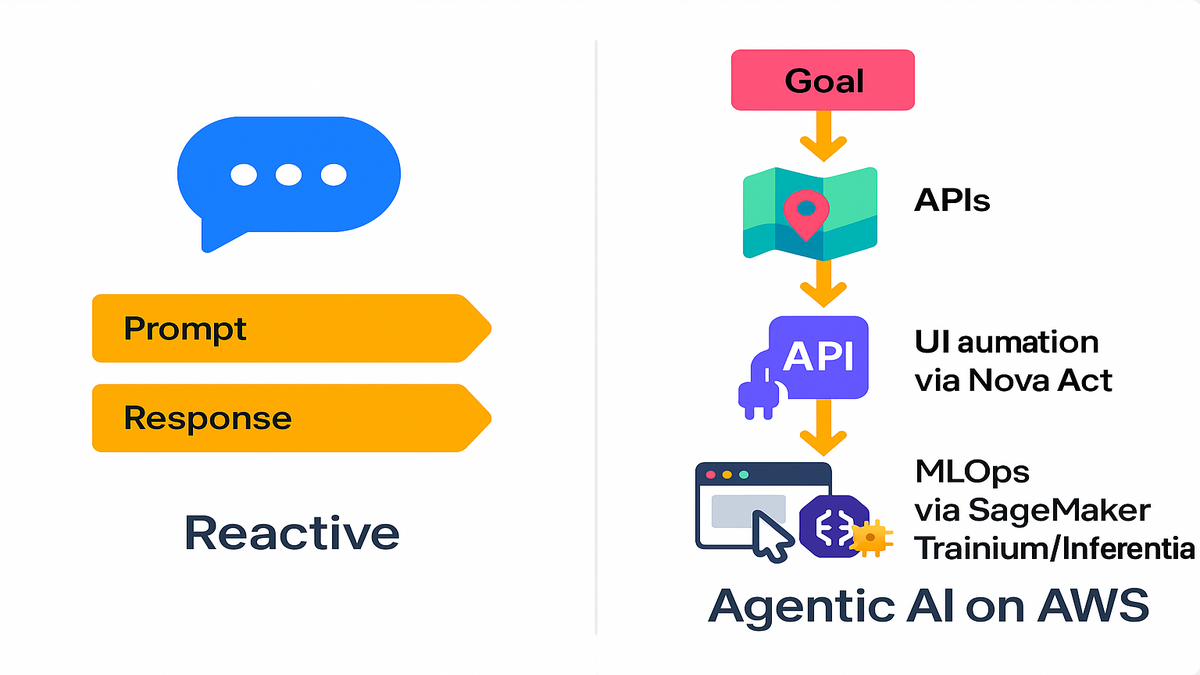
Old-school chatbots react to prompts. Agentic AI sets goals, plans tasks, and executes. The big unlock is autonomy. Agents don’t just generate text. They coordinate actions across APIs, databases, and UIs to deliver outcomes. Think: “Reconcile invoices, update the ERP, notify the vendor, then draft the summary.”
With AWS, the pieces finally click. You get compute tuned for high AI throughput with Trainium and Inferentia. You get a model ops backbone in SageMaker. And you get purpose-built agent capabilities. Amazon Nova Act handles production UI workflows without brittle RPA scripts. Kiro converts natural language into specs and functional code, so you stop starting from scratch.
Under the hood, strong agents loop through plan-act-observe. They break goals into steps, pick a tool, take an action, then check results. They adjust after they observe. That loop is the gap between a neat answer and a resolved ticket. You can run one agent or many. Each can own a slice of the workflow and coordinate like a team.
In practice, a planner breaks down the goal and a router picks APIs or a UI flow. A memory layer keeps context. Evaluators act like your unit tests. When something fails, the agent re-plans or escalates instead of hallucinating its way forward.
Why it matters
- Outcome > output: You don’t want an answer. You want a resolved ticket.
- Fewer brittle links: Purpose-built infrastructure beats that 12-tool Jenga tower.
- Shorter path to value: Agents can plan and act on messy, multi-step work.
As statistician George Box said, “All models are wrong, but some are useful.” Agentic AI on AWS is useful because it avoids the worst failure mode. Humans as glue. It replaces that with predictable orchestration, evaluation, and control.
For a pragmatic look at governance, evaluation, and monitoring patterns, see our Features.
One more reason it matters: risk. Many AI pilots stall because teams fear production blowups. The AWS stack helps you design guardrails from day one. Permissions, logging, and observability. Start small, measure impact, and expand without waking your compliance team at 2 a.m.
The AWS angle on frontier
People search for “aws frontier agents” because they want the latest stuff. On AWS, “frontier” isn’t one product. It’s the mix of high-performance silicon, mature MLOps, and agent services built for reliability. You bring your favorite models. AWS gives you rails so they do real work safely at scale.
Those rails include hardened orchestration, identity and access controls, and encrypted storage. Plus monitoring that survives real traffic. You can run agents in a dedicated account and route events through a workflow engine. Lock down secrets and send every action to an audit log. It’s not flashy, but it turns a demo into a dependable production system.
Meet the stack
Amazon Nova Act
Nova Act manages fleets of agents that automate production UI workflows at scale. It runs a custom Nova computer-use model under the hood. Translation: faster time-to-value with far less fragility than old RPA. If your process lives in web apps, internal dashboards, or legacy UIs, Nova Act helps. It turns “screen scraping” into a first-class, resilient capability.
What you get: orchestrated UI actions, reliability primitives, and scale. What you avoid: per-page regex hacks that shatter when someone moves a button.
Practical example: your supplier portal has no APIs for change orders. An agent can sign in, find the order, update fields, and upload a file. Then confirm the change. It ships with screenshots, logs, and retries baked in. If the UI shifts a bit, the agent adapts instead of face-planting.
Kiro for builders
Kiro is an AI-powered IDE that turns natural language into specs and working code. It’s ideal when the workflow lives in your heads. Prompt Kiro with goals, constraints, and tools. It drafts scaffolding for agents, tools, and evaluators. Your team reviews, hardens, and ships. Less yak-shaving, more progress.
Treat Kiro like your pair programmer for boilerplate. You describe inputs, edge cases, and “done” conditions. It generates the skeleton with tests. You still own the APIs, secrets, and production hardening. But you skip weeks of wiring.
AWS Marketplace
Don’t build everything. AWS Marketplace gives you hundreds of AI agents, tools, and solutions from AWS Partners. Automate processes, extend your stack, or stand up domain agents. If you’re mapping “aws partner agentic ai essentials,” start here. Deploy vetted components and focus on your edge.
Bonus: Marketplace makes procurement easier. You get clear pricing and usage tracking. You also get options like private offers. Grab a document-processing agent or a policy evaluator. Plug it into your workflow and move faster with less risk.
Foundation technologies
- Amazon SageMaker: build, train, deploy models with MLOps guardrails, experiment tracking, and CI/CD for ML.
- AWS Trainium and Inferentia: purpose-built chips that cut training and inference cost at scale.
- Vertically integrated data centers and custom silicon: performance, consistency, and cost profile tuned for production.
As Alan Kay put it, “The best way to predict the future is to invent it.” With this foundation, you’re not inventing alone. You’re standing on rails designed for agentic workloads.
Round out the foundation with orchestration, security, and observability. Use a workflow engine to manage retries and timeouts. Use IAM to scope permissions and encrypted secret storage. Add monitoring dashboards, alarms, and audit logs. These are boring but critical. They make agents safe at 3 p.m. and 3 a.m.
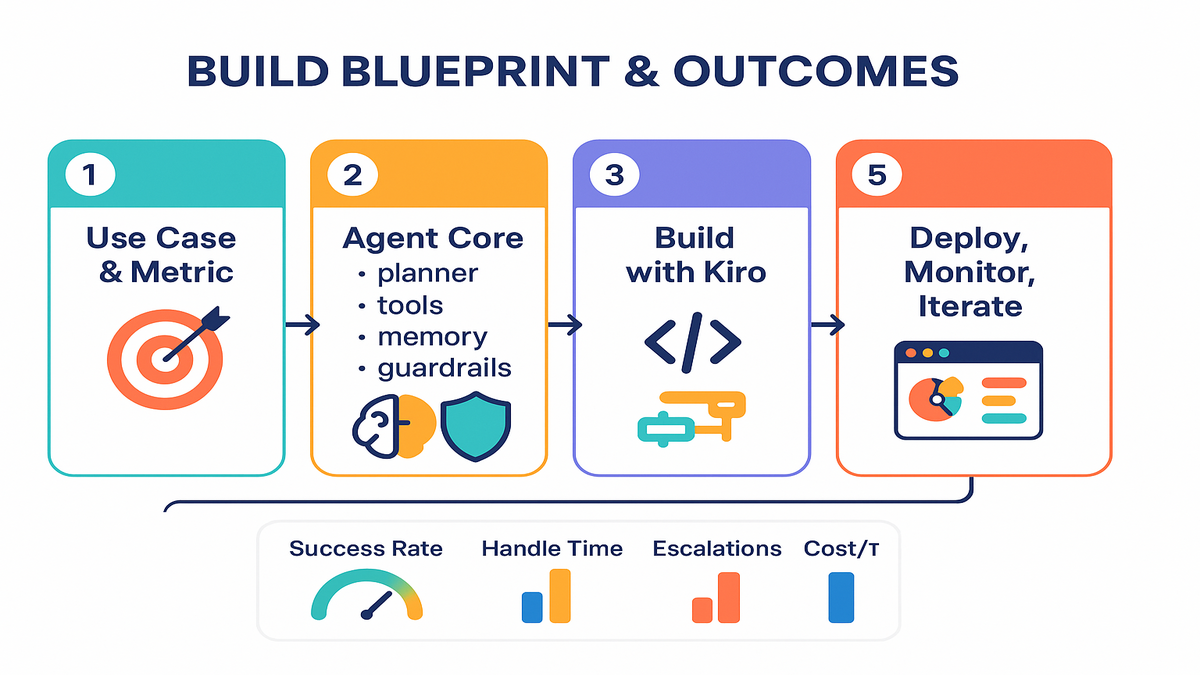
Production agent blueprint
1 Nail the use case
Pick high-friction, rules-heavy work with measurable outcomes. “Reduce order exception handling time by 60%.” “Close 20% more support tickets autonomously.” “Generate compliant RFP responses in 10 minutes.” Document inputs, systems touched, edge cases, and the “done” definition.
Add a quick spec template:
- Goal: clear statement of what “done” means.
- Inputs: data sources, forms, attachments, APIs.
- Systems: CRMs, ERPs, portals, file stores.
- Constraints: SLAs, budgets, compliance, risk levels.
- Edge cases: missing data, timeouts, conflicts.
- Acceptance tests: golden cases the agent must pass.
2 Design the agent core
Agent core means planning, tool selection, memory, and control. On AWS, compose this with SageMaker-hosted models or your choice. Use Nova Act for UI actions and your APIs as tools. Add a vector or tabular memory store. Build a policy layer for what the agent can and cannot do.
- Planner: decomposes goals into steps.
- Tool router: maps steps to APIs, databases, or Nova Act UI flows.
- Memory: caches context and results to avoid redundant work.
- Evaluator: checks outputs against specs, re-plans on failure.
Design tips:
- Keep tools deterministic and well-documented. Prefer idempotent APIs.
- Separate read tools from write tools and add extra checks before writes.
- Make escalation a feature, not a failure. Define when to hand off and how to package context.
3 Implement with Kiro
Feed Kiro your spec with goals, acceptance criteria, tool schemas, and guardrails. It generates code scaffolding for agents, tools, and evaluators. You wire credentials, environment variables, and runtime configs. Keep it simple. One agent, a handful of deterministic tools, and crisp acceptance tests.
Treat your tool catalog like an internal API marketplace. Every tool should have:
- A schema for inputs and outputs, plus examples.
- Clear permissions and rate limits.
- Unit tests and documented failure modes.
4 Orchestrate and harden
Use orchestration that can retry and checkpoint. For long, multi-step tasks, combine Nova Act for UI and your APIs. Use a state machine, like your preferred workflow service, for retries, branching, and timeouts. Add a feedback loop. Failed runs log root causes. The planner learns to avoid repeats.
Guardrails: permissions by system, PII redaction, and rate-limiting. Keep immutable logs. Evaluation: golden tests, adversarial cases, and “shadow mode” alongside humans for one to two weeks. Flip to “auto-resolve” after that.
Operationalize from day one:
- Metrics: success rate, average handle time, escalation rate, cost per task.
- Alarms: trigger on error bursts, slowdowns, or budget thresholds.
- Traces: capture steps, inputs, outputs, and decisions.
5 Deploy monitor iterate
Ship to staging and soak test with real tasks, then promote. Watch SLAs closely. Success rate, handle time, escalation rate, and cost per task. Tighten tools, prompts, and evaluator thresholds weekly. Expand scope only after you stabilize.
Pro tip: use a “center of excellence” model. One platform team packages reusable patterns. Domain teams own use cases.
Iteration cadence that works:
- Weekly: review failed runs, add rules and tests, retire flaky prompts.
- Biweekly: expand scope with one new tool or one new edge-case class.
- Monthly: re-baseline goals and prune manual steps the agent no longer needs.
Use cases that print ROI
Trip planning that books
Consumer example: an agent plans a 4-day Tokyo trip within budget. It books flights, hotels, and activities via partner APIs. It confirms receipts via UI workflows where APIs don’t exist. Nova Act handles the UI. A planner coordinates constraints like budget, dates, and loyalty programs. Memory stores user preferences and past itineraries. You move from “nice list” to “paid confirmation.”
Builder notes:
- Tools: flight and hotel APIs, calendar, payment provider, document store.
- Guardrails: spending limits, cancellation rules, and manual approval for big purchases.
- Evaluation: price checks, duplicate booking detection, and confirmation parsing.
Supply chain exceptions
Enterprise example: the agent monitors POs and flags stockouts early. It simulates options like expedite or reroute and updates the ERP via API. When needed, it uses Nova Act to issue change requests in vendor portals. It drafts stakeholder updates and only escalates when policy thresholds hit. Outcome: fewer late shipments and fewer 3 a.m. calls.
Builder notes:
- Tools: ERP APIs, vendor portals via UI, notifications, and a cost model.
- Guardrails: max expedite cost, carrier preferences, and approval tiers.
- Evaluation: SLA impact estimates and side-by-side checks with human decisions.
Customer support that closes
Support example: the agent classifies the issue and retrieves policy rules. It runs diagnostics, applies fixes, and updates the CRM. High-risk cases auto-escalate. Everything else closes with a full trace. This is where “aws agentic ai” shifts from deflection to resolution.
If you’re hunting “aws frontier agents,” think of these as proven patterns. They use today’s best models, tool routers, and UI automation. They’re backed by MLOps you can audit.
Partner accelerators
You don’t need to reinvent every wheel. Pull domain agents and evaluators from AWS Marketplace. Speed up onboarding, compliance, or finance ops. That’s your “aws agentic ai portfolio.” A mix of in-house agents and partner solutions that compounds over time.
Finance ops with receipts
Finance example: the agent ingests receipts and normalizes vendor names. It matches line items to cost centers and flags out-of-policy spend. Then it posts journal entries. If a receipt is missing, it pings the employee and waits. Then it closes the loop. UI automation picks up where APIs are inconsistent.
Builder notes:
- Tools: OCR and doc processing, accounting APIs, a policy engine, email or chat.
- Guardrails: posting limits, period-close windows, and segregation of duties.
- Evaluation: sample audits against human-reviewed entries.
Quick pulse check
- You’ve picked one measurable, rules-heavy workflow with a clear “done.”
- You defined an agent core: planner, tool router, memory, evaluator, and guardrails.
- You’re using Nova Act for UIs and clean APIs for everything else.
- Kiro generated scaffolding; your team hardened it with tests and limits.
- You’re tracking success rate, handle time, escalations, and cost per task—and iterating weekly.
If any box is unchecked, pause and fix it before scaling. Agents amplify whatever process you hand them—good or bad.
FAQ Agentic AI on AWS
AWS Transform agents
There isn’t an AWS service literally called “Transform” that deploys agents. Practically, you deploy specialized agents on AWS using components like Amazon Nova Act for UI workflows. You use SageMaker-hosted models and tools and partner solutions from AWS Marketplace. You tailor agents to domains like support, supply chain, and finance by composing tools, policies, and evaluators.
Purpose of agentcore
“Agent core,” often stylized as agentcore, is the orchestration brain. It plans tasks, selects tools like APIs, databases, and Nova Act UI flows. It manages memory, enforces guardrails, and evaluates outputs. On AWS, you implement this with your model runtime in SageMaker, a workflow layer, Nova Act for UI actions, and evaluators. It’s not a single product named AgentCore.
Nova Act and Kiro
Kiro speeds up build time by turning specs into code and tests. It handles your agent, tools, and evaluators. Nova Act executes the hands-on keyboard parts. It navigates production UIs reliably. Use Kiro to assemble the brain and tools. Use Nova Act when the workflow needs clicking through real interfaces.
AWS frontier agents
“Frontier” refers to state-of-the-art agent capabilities. On AWS, you compose frontier agents by pairing strong models with robust orchestration. Add Nova Act for UI automation and partner tools where needed. The edge isn’t one model. It’s the reliability and governance of the end-to-end system.
AWS partner essentials
Begin with vetted agents and tools from AWS Marketplace aligned to your domain. Think customer support triage, document processing, or supply chain. Look for solutions with clear SLAs, evaluation suites, and compliance artifacts. Use them as building blocks in your agentic portfolio. Invest engineering time where your process is unique.
Keeping agents compliant
Define strict permissions, rate limits, and escalation rules. Log every action, always. Add pre- and post-execution evaluators. Run in shadow mode before autonomy. Use data protection like tokenization and PII redaction. Regularly review outputs against policy and compliance requirements.
Standardize on one model
Nope. Many teams mix models by task. Cheaper models for classification or routing. Larger ones for planning or generation. Decouple the agent brain from the model. Then you can swap models without rewriting tools and tests.
Estimate and control cost
Start with a per-task budget target. Measure tokens, API calls, and UI steps. Optimize by caching context and pruning verbose traces. Pick lighter models for simple steps and batch where safe. Set alarms when cost per task drifts up.
Agentic AI vs RPA
RPA scripts follow brittle, pre-recorded paths and break on small UI changes. Agentic AI plans, chooses tools, and adapts in real time. It can switch from an API to a UI flow and retry with different parameters. Or escalate with a clean summary when blocked.
Launch your first agent
- Day 1: Pick one workflow and write the spec, inputs, steps, and “done.”
- Day 2: Define tools like APIs and databases and where Nova Act handles UIs.
- Day 3: Use Kiro to generate scaffolding for agent, tools, evaluators, and tests.
- Day 4: Wire credentials, add guardrails, and build a golden test suite.
- Day 5: Shadow mode with real tasks and fix failure modes fast.
- Day 6: Small-scale production; watch success rate, handle time, and escalations.
- Day 7: Iterate; lock in the metric, then expand scope.
You don’t need a moonshot. You need one agent that moves a KPI forward.
Two more tips for the week: keep scope tight. One agent, three tools, and ten golden tests. Meet daily to review failures. The fastest teams treat failures like gold. Each one becomes a new rule, test, or tool improvement.
If you’re serious about shipping agents, this is your window. Start with one painful workflow and wire an agent core that plans and acts. Put it on rails you trust. AWS’s agentic stack pushes you past the demo trap. Nova Act for UI resilience, Kiro for build speed, and SageMaker with custom silicon for performance. Marketplace partners fill gaps. Do the unglamorous parts like guardrails, evaluation, and monitoring. You’ll move from “prompts” to “outcomes” fast.
Want help and reps? The 6-week “Agentic AI on AWS” cohort kicks off February 21, 2026. Hit the BeSA website, grab a seat, and turn ideas into agents that ship work.
Want proof this approach works in-market? Explore our Case Studies for real-world outcomes.
References
- Amazon SageMaker — Build, train, and deploy ML models
- AWS Trainium — Purpose-built ML training chips
- AWS Inferentia — High-throughput, low-latency inference
- AWS Marketplace — Discover and deploy partner AI solutions
- Responsible AI on AWS — Governance and best practices
- AWS Step Functions — Workflow orchestration for reliable automation
- Agents for Amazon Bedrock — Build agents powered by foundation models
- AWS Well-Architected Reliability Pillar
- Amazon CloudWatch — Metrics, logs, and alarms
- AWS Identity and Access Management (IAM) — Fine-grained permissions
- AWS Key Management Service (KMS) — Managed encryption keys
- AWS Secrets Manager — Rotate, manage, and retrieve secrets
- AWS CloudTrail — Governance, compliance, and operational auditing
- Amazon EventBridge — Serverless event bus for integration
- Amazon Virtual Private Cloud (VPC) — Network isolation and control
- Amazon GuardDuty — Threat detection and monitoring